YAC-OSP Governance & Ethics Course
A rigorous programme covering Ghana's Companies Act, directors' duties, conflicts of interest, ethical dilemmas, and the legal framework governing corporate whistleblowing.
If the issue persists, kindly contact request@osp.gov.gh for assistance.
Course Modules
📌 How This Course Works
- Complete each lesson in order — the next lesson unlocks after you finish the previous one.
- After completing all 5 modules, the final quiz will unlock.
- Score 3 out of 5 or more to earn your certificate.
- Your progress is automatically saved in your browser.
The Company as a Legal Person
Every registered company is a separate legal person. That person can own property, sue and be sued, and enter contracts — but it cannot speak, decide, or act on its own. Real, physical human beings must act on its behalf.
This creates an immediate question: Who decides? Who controls? And who is held accountable when things go wrong?
Governance is the answer to those questions.
Governance is the way in which a company is managed and controlled. It covers who makes decisions, how they are held accountable, and how risks are identified before they become crises.
Three Problems Governance Solves
- The agency problem — Managers run companies they do not own. Without governance, they may run it for their own benefit, not shareholders'.
- The information asymmetry problem — Executives know more than shareholders. Governance requires disclosure to level the playing field.
- The accountability problem — Without clear rules, no one is responsible when something goes wrong. Governance assigns responsibility.
Ghana's Primary Governance Law
In Ghana, the primary law governing companies is the Companies Act, 2019 (Act 992). Two provisions define who governs and how:
Section 144 of Act 992 states that a company acts through its members in a general meeting, its board of directors, and its officers, agents, and servants. Critically, the board, when acting within its powers, is not bound to comply with the directions of the members. This is the principle of board primacy — the board, not shareholders, manages day-to-day operations.
What "Board Primacy" Means in Practice
Board primacy is not a licence for directors to ignore shareholders entirely. It means that within the scope of the company's constitution, the board's strategic and operational decisions are final — even if shareholders disagree.
Shareholders retain their power through elections (electing and removing directors), approval of major transactions, and dividend decisions. But they cannot micromanage the board on day-to-day matters.
A multinational company has a subsidiary in Accra. The foreign parent company — which owns 80% of the shares — instructs the local board to sign a major supply contract. The local board's legal team believes the contract exposes the subsidiary to significant legal risk and may harm the company's financial position.
What Can the Local Board Do?
Under Section 144(4) of Act 992, the local board can refuse. Even though the parent owns the majority of shares, the board is not bound to comply with shareholder directions when acting within its powers.
The board's duty is to the company — not to the parent shareholder. If the board genuinely believes the contract harms the company, they are not only permitted to refuse — they may be required to refuse under their fiduciary duties.
How Should the Board Handle It?
- Request the instruction in writing from the parent.
- Record in board minutes that the board considered the instruction and their legal duty.
- Seek an independent legal opinion.
- If the parent persists, escalate to the company's audit committee or seek court guidance.
The Professional Meaning of Ethics
In everyday conversation, "ethics" is often confused with personal feelings, religious values, or vague notions of being "a good person." For a corporate leader, ethics means something more precise: applying consistent principles when facing a decision that affects others.
Ethical professionals do not make decisions based on how they feel in the moment. They apply a structured test — and they apply it the same way every time, regardless of who is watching.
The Publicity Test
The most reliable and universally applicable ethics test is the "publicity test":
Would you be comfortable explaining your decision — in full detail — on national television?
If yes, proceed. If not, do not do it. This test cuts through rationalisation and forces you to consider how your decision would look to an objective observer.
Why Feelings Are Not Enough
Feelings can mislead. A corrupt act can feel justified ("this company has plenty of money"), convenient ("everyone does it"), or even altruistic ("I'm doing this for my family"). The publicity test bypasses feelings and asks: what would a reasonable, informed outsider think?
Ethics Backed by Law
In Ghana, ethical conduct by directors is not merely expected — it is a legal obligation. Two provisions of Act 992 form the core of a director's ethical duty.
Section 190 of the Companies Act, 2019 (Act 992) imposes a duty on every director to "act in good faith and in what the director believes to be the best interests of the company."
This is a standard-based duty — it requires honest judgment, not perfect results. A director who genuinely believed a decision was in the company's best interest, even if it turned out to be wrong, is generally protected. A director who knew a decision was harmful but proceeded anyway is not.
Section 191 adds that a director must exercise powers for a proper purpose. A power granted for one purpose cannot be used for another — even if technically within the director's authority.
Classic improper purpose example: issuing new shares is a legitimate power — but using that power to dilute a shareholder who is trying to remove you, purely to protect your position, is an improper purpose. The act (issuing shares) may be lawful; the purpose (self-preservation at the company's expense) is not.
What This Means for You
Every time you exercise a power as director or officer, ask:
- Am I genuinely acting in the company's best interests?
- Is this the purpose this power was designed for?
- Can I honestly document my reasoning in the board minutes?
The Core Definition
A conflict of interest arises when a director or senior manager has a personal interest — financial, family, or through friendship — that could improperly influence their professional duty to the company.
Types of Personal Interest That Create Conflicts
- Financial interest — You own shares in, or receive fees from, a company doing business with yours.
- Family interest — A close relative has a material interest in a transaction or decision.
- Friendship/loyalty — A close personal relationship creates pressure to favour someone over the company's best interest.
- Reputational interest — You personally benefit from a decision in ways not financial but that advance your career or public standing.
The Disclosure Principle
Ghana's corporate governance framework — and most international frameworks — operates on a simple principle: declare the conflict, let the board decide. Once declared, the board can manage it appropriately. Undisclosed conflicts, by contrast, corrupt the entire decision-making process.
A director who is interested in a contract or proposed transaction with the company must declare the nature of that interest at a board meeting. The declaration must be recorded in the board minutes. Failure to disclose makes the director personally liable for any profit made from the undisclosed transaction.
Three Requirements Under Section 195
- Declare at a board meeting — Informal disclosure to the CEO or chairman is not sufficient. It must be raised formally at a board meeting.
- Declare the nature of the interest — Not just "I have a conflict" but the specific relationship: "I own 30% of XYZ Ltd, which is bidding for this contract."
- Ensure it is recorded in the minutes — The company secretary must capture the disclosure in the official meeting minutes.
Register of Directors' Interests
In addition to meeting-by-meeting disclosure, good governance requires a Register of Directors' Interests — a standing record of all material interests held by each director. While Act 992 does not explicitly name this register, the National Corporate Governance Code 2021 (issued by the Institute of Directors Ghana) requires it.
Your brother-in-law's company bids for a cleaning contract with your organisation. You are a member of the procurement committee evaluating bids.
You own a 25% stake in a technology startup. The startup now wants to sell software to your company. The contract value is GHS 500,000.
The Pattern in Both Cases
Notice the consistent pattern: early disclosure → documented recusal → independent review. This three-step process protects you, the company, and the integrity of the decision.
During the Ghanaian banking crisis of 2017–2019, several failed banks had directors who approved loans to their own companies, businesses owned by relatives, and entities in which they had material financial interests — without disclosing those interests to the board. In multiple cases, the boards approved transactions in which their own members were beneficiaries.
The Result
When the Bank of Ghana intervened, it found that related-party lending — lending to persons or companies connected to directors — was one of the primary causes of the failures. Billions of cedis were lost. Thousands of depositors were affected. Several directors faced receivership proceedings and personal liability claims.
The Regulatory Response
The Bank of Ghana Corporate Governance Directive (2018) now requires banks to have an independent director review all related-party transactions. Banks must maintain detailed related-party registers and obtain prior regulatory approval for transactions above defined thresholds.
The Ghana banking crisis is one of the clearest demonstrations in African corporate history of what happens when boards fail their governance duties on conflicts of interest. The financial cost exceeded GHS 21 billion in bailout funds.
The Register of Interests Test
One of the simplest and most revealing governance health checks you can perform requires no consultant, no external audit, and no additional budget.
At your next board meeting, ask to see the Register of Interests. Then observe the response.
How to Read the Response
- If the register is comprehensive — with multiple entries from different directors showing their interests — you are in a healthy governance environment. Transparency is normalised.
- If the register is empty — ask why. Either no director has any material interests (unlikely in a substantial company) or the register is not being maintained. Either way, it needs investigation.
- If no register exists — this is a significant governance gap. Recommend immediate establishment of one and report to the audit committee.
A Dilemma is Not a Mess
People often use the word "dilemma" loosely to mean any difficult situation. In ethics, it has a precise meaning: a choice between two courses of action that each honour a legitimate value. Neither option is simply wrong. Both have moral weight.
This is fundamentally different from a conflict of interest, which involves self-interest vs. professional duty. In a dilemma, there is no self-interest — both choices serve others. The difficulty is choosing which obligation takes priority.
Common Dilemmas for Leaders
- Loyalty to a colleague vs. honesty to the board — You discover a trusted colleague has made a serious error. Covering it up protects them. Disclosing it protects the company.
- Short-term profit vs. long-term sustainability — Maximising this quarter's earnings requires cutting the training budget that builds tomorrow's leadership.
- Respecting confidentiality vs. preventing harm — An employee tells you in confidence something that, if true, could endanger other employees or the public.
When You Are Unsure If Something Is Wrong
In the real world, ethical decisions are rarely obvious. When you're unsure whether an action is right or wrong, use this five-question test to guide you.
The 5-Question Ethics Test
Under stress, the brain defaults to familiar patterns and rationalisations. Ethical frameworks exist to override that instinct and force a disciplined analysis. The Five-Question Test is designed to work precisely when you feel most pressured.
- Is it profitable? (Economic test)
- Is it legal? (Compliance test)
- Is it fair? (Equity test)
- Is it right? (Values test)
- Is it sustainable? (Long‑term test)
Applying the Five Questions to Corruption Scenarios
Below is a step‑by‑step guide for using the core five‑question model to analyse a corruption‑related situation (e.g., a bribe offered to win a contract, embezzlement of public funds, or a conflict of interest).
1. Is it Profitable? (Economic Test)
Ask: Does the corrupt act bring financial gain to the individual or organisation?
A company is offered a lucrative government contract if it pays a “facilitation fee” to an official. On the surface, the deal is highly profitable.
2. Is it Legal? (Compliance Test)
Ask: Does the action violate any local, national, or international law?
The payment to the official is a bribe, which is illegal under anti‑corruption statutes (e.g., the Ghanaian Criminal Offences Act, or the UN Convention against Corruption).
3. Is it Fair? (Equity Test)
Ask: How does the decision affect different stakeholders? Is the distribution of benefits and burdens just?
The bribe allows one company to win a contract over competitors who bid fairly. Employees of the losing firms may lose jobs; taxpayers may pay more for inferior work.
4. Is it Right? (Values Test)
Ask: Does the action align with fundamental moral principles (honesty, integrity, duty of care) and the organisation’s stated values?
Paying a bribe involves deception and betrayal of trust. It contradicts the values of integrity, transparency, and accountability that anti‑corruption bodies like the OSP promote.
5. Is it Sustainable? (Long‑Term Test)
Ask: Does the decision consider the long‑term impact on the environment, society, and the organisation’s reputation?
A corrupt deal may lead to systemic corruption, erosion of public trust, and a culture of impunity. It can also lead to environmental damage if the corrupt project bypasses safeguards.
Your company discovers that a popular consumer product has a minor defect — it does not cause injury, but it may fail two months earlier than advertised. Recalling the product will cost GHS 10 million and hurt quarterly earnings significantly. Doing nothing preserves short-term profit and protects jobs in the near term.
Mapping the Dilemma
- Stakeholders affected: Customers (trust and value), shareholders (financial performance), employees (job security), regulators (compliance obligations).
- Values in tension: Immediate financial stewardship vs. long-term reputation. Short-term job protection vs. customer trust.
Applying the Governance Answer
The board must be informed — immediately. If the product is misrepresented (it fails earlier than marketed), the duty of good faith under Section 190 of Act 992 requires the board to act in the company's genuine best interests. Staying silent about a known defect is not in the company's long-term interests — it is a gamble that the defect will not surface publicly.
Additionally, consumer protection obligations under the Consumer Protection Act, 2020 (Act 1079) may require disclosure and recall regardless of the board's preference.
Takata, a major Japanese automotive parts manufacturer, discovered in the early 2000s that its airbag inflators could rupture violently, sending metal shrapnel into vehicle occupants. Internal data showing the defect was suppressed for years. Management chose secrecy over disclosure and recall — the dilemma: an expensive, reputation-damaging recall vs. a quiet internal "fix."
What They Chose
Takata suppressed the data, continued to supply defective airbags to major automakers, and attempted internal corrections without public disclosure. The defect was eventually traced to 17 deaths and over 400 injuries worldwide.
The Result
Takata filed for bankruptcy in 2017 with liabilities exceeding USD 10 billion. Multiple executives faced criminal charges. The company ceased to exist. The recall — when it finally happened — became the largest automotive recall in history, covering over 100 million vehicles across dozens of manufacturers.
A Process, Not a Personality
Many executives believe ethical leadership is about having the right character. Character matters — but in a corporate context, process is more important than personality. A good process produces defensible decisions even under extreme pressure. A reliance on personality alone fails when the leader is tired, stressed, or conflicted.
The Four-Step Leadership Process for Dilemmas
1
Call a special board meeting — not email, not a WhatsApp message. A formal meeting creates a proper record, requires preparation, and signals the seriousness of the issue. Email trails can be edited or deleted; board minutes cannot.2
Invite legal and ethics advisors — independent voices reduce groupthink. In-house counsel knows the law; an external ethics advisor can provide the outside perspective your team lacks.3
Document the reasoning in the minutes — minutes must show that you considered all stakeholder interests, weighed competing values, and applied the legal framework. A well-documented decision is your protection if the outcome is later questioned.4
Never make the decision alone — a collective board decision is substantially harder to challenge than an individual executive's decision. Collective governance is both a legal requirement and a practical shield.
The Executive's Instinct — And Why It Is Wrong
Most executives, when they hear that an employee has reported the organisation to a regulator or external authority, feel a visceral reaction: betrayal. This instinct is understandable — and deeply counterproductive.
An employee who reports wrongdoing is not betraying the company. They are saving the company from a future scandal — often at significant personal risk to themselves.
The Pattern of Major Corporate Failures
The worst corporate collapses in modern history — Enron, WorldCom, the Ghanaian banking crisis — shared a common feature: there were always internal people who knew. The problem was never a lack of information. It was the absence of a safe, credible channel to report it.
A well-governed company does not merely tolerate whistleblowing — it actively creates and protects the channels through which employees can report wrongdoing. Safe reporting channels are a governance asset, not a liability.
What Leaders Must Do
- Champion the culture publicly — State explicitly, in writing and in person, that the company protects whistleblowers.
- Establish independent channels — hotlines, anonymous web forms, or an independent audit committee contact — that bypass line management.
- Investigate reports seriously — ignoring or dismissing a report is itself a governance failure.
Protects any person who makes a disclosure of impropriety — including corruption, fraud, waste, or danger to public health — to an appropriate authority. The Act prohibits victimisation of whistleblowers and provides for compensation if harm occurs. Both employees and non-employees (including contractors and members of the public) can make protected disclosures.
Establishes the OSP to investigate and prosecute corruption. The OSP can receive anonymous tips and is required by law to protect whistleblowers who report to it. The OSP's independence from the Attorney-General means that politically sensitive reports have a credible, protected channel.
Gives the court power to grant relief if a company's affairs are conducted in an oppressive manner. A whistleblower who is also a shareholder can use this section to challenge retaliation — including constructive dismissal, systematic exclusion from management, or denial of information rights.
A senior manager learns that a junior staff member reported the manager's close friend — another employee — for inflating travel claims. The manager, feeling that the whistleblower acted disloyally, wants to transfer the junior staff member to a less desirable department in a remote location.
Analysing the Situation
- Is this retaliation? Yes. The proposed transfer is directly connected to the employee's protected disclosure. The fact that it is a "transfer" rather than a "dismissal" does not change its nature.
- What does the law say? Under the Whistleblower Act, 2006 (Act 720), victimising a whistleblower — including through demotion, unfavourable transfer, harassment, or discrimination — is a criminal offence.
The Board's Responsibility
When a board is informed of potential whistleblower retaliation and takes no action, the board members themselves may face liability. Wilful blindness is not a defence. If you become aware of a retaliation risk, you are obliged to act.
In one of Ghana's collapsed banks during the 2017–2019 crisis, a treasury officer discovered that the CEO was secretly transferring funds to a related-party entity — one in which the CEO had an undisclosed interest. The treasury officer reported the suspicious transactions to the bank's internal audit committee.
What Happened Next
The internal audit committee, possibly intimidated by the CEO's seniority or themselves conflicted, took no action. The treasury officer then escalated directly in writing to the Bank of Ghana.
The Outcome
The bank subsequently collapsed and was placed in receivership. The treasury officer's documented evidence became a central part of the receivership proceedings. The officer kept their job, was protected by the regulatory process, and was formally praised in the official report on the bank's collapse.
For the individual: When internal channels fail, external escalation is both legally protected and often necessary. The treasury officer did not break loyalty — they fulfilled it, to the institution rather than to a corrupt individual.
For the board: An internal audit committee that fails to act on a serious report is not neutral — it becomes part of the governance failure. The committee's inaction likely extended the bank's collapse and deepened the eventual losses.
📝 Final Assessment Quiz
Test your understanding of YAC-OSP Governance & Ethics Course.
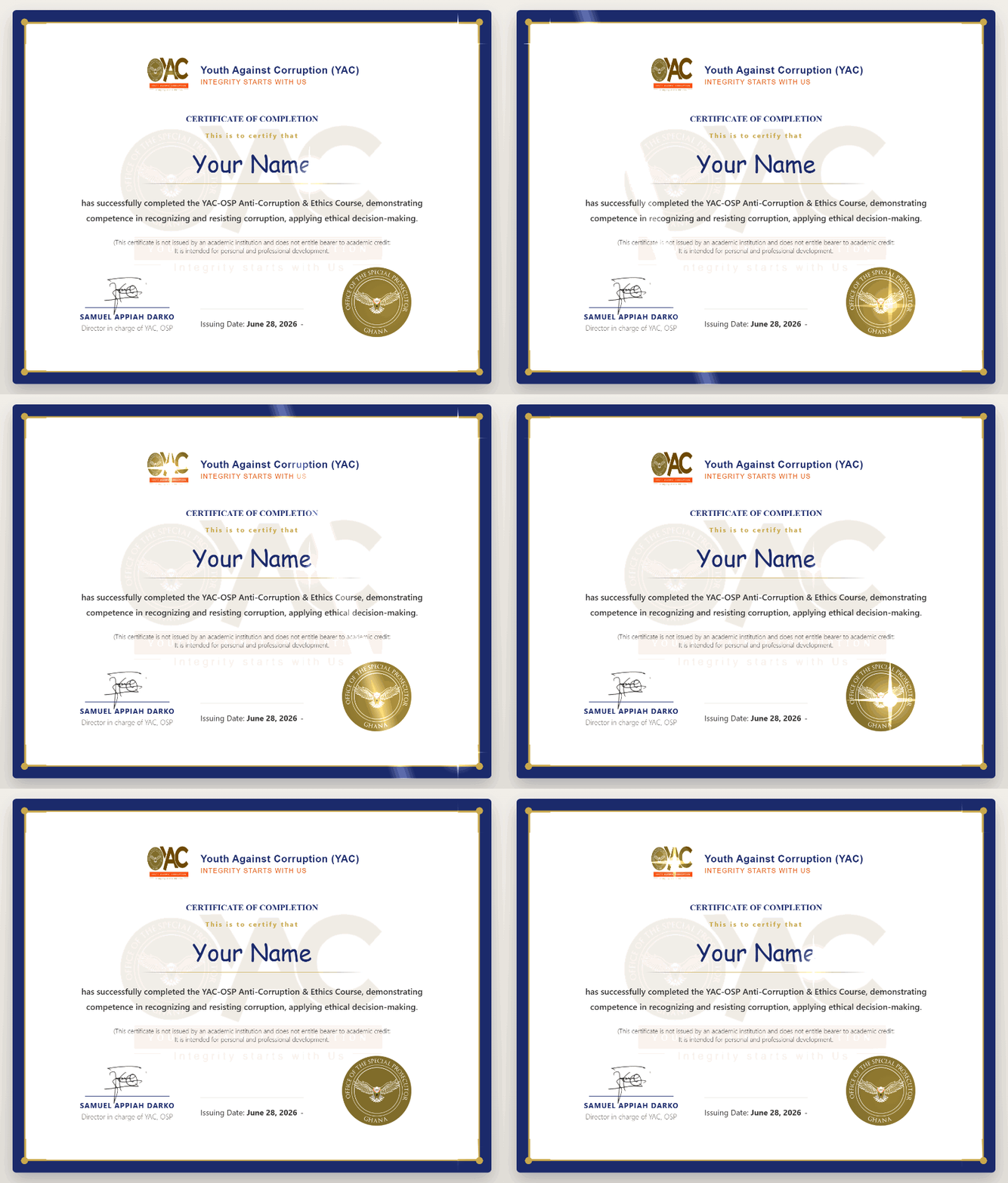
CERTIFICATE OF COMPLETION
This is to certify that
Eugene Fiifi Brown
has successfully completed the YAC-OSP Governance & Ethics Course, demonstrating competence in recognizing and resisting corruption, applying ethical decision-making.
(This certificate is not issued by an academic institution and does not entitle bearer to academic credit:
It is intended for personal and professional development.)
Samuel Appiah Darko Esq.
Director in charge of YAC, OSP