YAC-OSP Anti-Corruption & Ethics
A practical guide to help you recognise, resist, and report corruption in your daily life — whether you are a student, teacher, nurse, office worker, business owner, or public servant.
If the issue persists, kindly contact request@osp.gov.gh for assistance.
Course Modules
📌 How This Course Works
- Complete each lesson in order — the next lesson unlocks after you finish the previous one.
- After completing all 5 modules, the final quiz will unlock.
- Score 14 out of 15 or more to earn your certificate.
- Your progress is automatically saved in your browser.
Introduction
Corruption is not just about politicians stealing millions. It happens in small ways every day,in your school, your workplace, your hospital, and on the street.
Examples You May Have Seen or Experienced
- A teacher asking for money before giving a student a passing grade.
- A nurse demanding a "gift" before attending to a patient.
- A police officer stopping a driver for a minor offence and asking for "something small" instead of issuing a ticket.
- A school administrator asking parents to pay for textbooks that are supposed to be free.
- A company manager hiring his relative instead of a more qualified candidate.
Why Small Acts Matter
Many people think corruption only refers to grand-scale theft or bribery at the highest levels of government. But the reality is that corruption thrives in small, normalised acts. When small acts go unchallenged, they create a culture where bigger acts of corruption become acceptable.
Every time someone accepts a bribe, pays a bribe, or stays silent about corruption,they are feeding the system.
A Common Misconception
You might think: "If I pay a small bribe to get my document processed faster, it's no big deal." But corruption has hidden costs that affect everyone : including you.
Real Impacts of Corruption
- Higher costs for everyone : When companies pay bribes, they add those costs to the price of goods and services. You pay more for everything.
- Poor public services : When money meant for roads, hospitals, and schools is stolen, you get bad roads and crowded classrooms.
- Unfairness : Hardworking people lose opportunities because someone else paid their way in. Merit stops mattering.
- Danger : Corrupt building inspections mean unsafe buildings. Corrupt drug approvals mean fake medicines.
In many countries, corruption in the health sector leads to fake or expired drugs being sold. These dangerous medicines injure and kill patients. The people most affected are those who cannot afford private healthcare.
The Ripple Effect
When one person pays a bribe, they signal to the system that bribery works. This encourages more corruption. Over time, the entire system becomes corrupt, and everyone suffers.
Honest Self-Reflection
Many people participate in corruption without realising it. Sometimes the line between social norms and corrupt behaviour is blurry. Take a moment to check yourself honestly:
- Have you ever given a small "tip" to a public official to get faster service?
- Have you ever asked someone to use their position to help you jump a queue?
- Have you ever kept quiet when you saw someone cheating because "it's not my business"?
- Have you ever accepted a favour from someone knowing they expect something in return?
Breaking the Cycle
If you answered "yes" to any of those questions, you are not alone. These behaviours are widespread, but that does not make them acceptable. The good news is: you can change today.
Small ethical choices add up. When enough individuals make the right choice, cultural norms begin to shift. Corruption is not inevitable, it is a choice that communities can choose to reject.
Module 1 Summary
You have now completed Module 1. You understand what corruption looks like in everyday life, how it harms everyone, and how your own choices contribute to, or fight against, a corrupt culture. In Module 2, we will explore how to make ethical decisions when under pressure.
When You Are Unsure If Something Is Wrong
In the real world, ethical decisions are rarely obvious. When you're unsure whether an action is right or wrong, use this five-question test to guide you.
The 5-Question Ethics Test
Under stress, the brain defaults to familiar patterns and rationalisations. Ethical frameworks exist to override that instinct and force a disciplined analysis. The Five-Question Test is designed to work precisely when you feel most pressured.
- Is it profitable? (Economic test)
- Is it legal? (Compliance test)
- Is it fair? (Equity test)
- Is it right? (Values test)
- Is it sustainable? (Long‑term test)
Applying the Five Questions to Corruption Scenarios
Below is a step‑by‑step guide for using the core five‑question model to analyse a corruption‑related situation (e.g., a bribe offered to win a contract, embezzlement of public funds, or a conflict of interest).
1. Is it Profitable? (Economic Test)
Ask: Does the corrupt act bring financial gain to the individual or organisation?
A company is offered a lucrative government contract if it pays a “facilitation fee” to an official. On the surface, the deal is highly profitable.
2. Is it Legal? (Compliance Test)
Ask: Does the action violate any local, national, or international law?
The payment to the official is a bribe, which is illegal under anti‑corruption statutes (e.g., the Ghanaian Criminal Offences Act, or the UN Convention against Corruption).
3. Is it Fair? (Equity Test)
Ask: How does the decision affect different stakeholders? Is the distribution of benefits and burdens just?
The bribe allows one company to win a contract over competitors who bid fairly. Employees of the losing firms may lose jobs; taxpayers may pay more for inferior work.
4. Is it Right? (Values Test)
Ask: Does the action align with fundamental moral principles (honesty, integrity, duty of care) and the organisation’s stated values?
Paying a bribe involves deception and betrayal of trust. It contradicts the values of integrity, transparency, and accountability that anti‑corruption bodies like the OSP promote.
5. Is it Sustainable? (Long‑Term Test)
Ask: Does the decision consider the long‑term impact on the environment, society, and the organisation’s reputation?
A corrupt deal may lead to systemic corruption, erosion of public trust, and a culture of impunity. It can also lead to environmental damage if the corrupt project bypasses safeguards.
The Hardest Skill in Fighting Corruption
One of the most challenging things is refusing to take part in corruption without damaging relationships or your career. The good news: there are scripts that work. Practice them until they feel natural.
When a Boss Asks You to Do Something Wrong
"I understand what you're asking, but that would violate our code of conduct. Can we find a different way?"
"I'm not comfortable with that. I'd like to check with the ethics officer first."
When a Colleague Pressures You
"Sorry, I can't help with that. I have too much to lose."
"Let's not go there. I value our friendship too much to get us both in trouble."
When Someone Offers You a Bribe
"No, thank you. I can't accept this."
"If I take that, I lose my job and my integrity. It's not worth it."
When You Are a Student and Someone Offers Exam Answers
"I'd rather pass on my own. Thanks anyway."
Why People Stay Silent
Many people witness wrongdoing but say nothing because they fear revenge, job loss, social exclusion, or not being believed. These fears are understandable — but you can report safely if you know how.
Practical Reporting Steps
- Gather basic facts first — Write down who did what, when, and where. Do not investigate yourself, that could put you in danger. Just document what you observed.
- Use anonymous channels — The OSP (Office of the Special Prosecutor) has anonymous web forms and hotlines. You can report without revealing your identity. Visit www.osp.gov.gh to report.
- Know your protections — Ghana's Whistleblower Act, 2006 (Act 720) and the Witness Protection Act, 2018 (Act 975) protect people who report corruption in good faith.
- Keep records — Save copies of any evidence. Do not share with colleagues, share only with authorities.
- Seek support — If you fear retaliation, tell a trusted family member or adviser. You should not face this alone.
Stage 2 Complete
You have now mastered the essential tools for ethical decision-making: the 5-question test, scripts for saying no, and how to report safely. Stage 3 applies these skills to real-world dilemmas.
You are a final-year student. A scholarship is available for one person in your class. Your best friend asks you to help them cheat on the qualifying exam. They promise to share the scholarship money with you if they win. You know you could easily help them without getting caught.
What Do You Do?
Before you act, think carefully:
- If you help, another deserving student loses the scholarship, someone who worked hard and played by the rules.
- Your friend might get caught, and both of you could be expelled.
- Even if you never get caught, you will always know you cheated. That knowledge affects your self-respect.
- Helping your friend cheat is not helping them, it is setting them up for a life of needing shortcuts.
You work in a procurement office. A supplier you have known for years comes to see you. They leave a small envelope on your desk with a note: "Just a small thank you for your time – no strings attached." Inside is a gift card worth $50.
What Do You Do?
Consider the full picture:
- The supplier may expect future procurement favours, even if they say "no strings."
- Even if their intentions are innocent, accepting creates a sense of obligation in your mind.
- Your company almost certainly has a policy against accepting gifts from vendors.
- If this ever came to light, it could end your career, even if you never gave the supplier any preferential treatment.
Your manager tells you to approve an invoice for work that was never done. The manager says: "Everyone does this. Just sign it. If you don't, I'll make sure you get the worst shifts for the next six months."
What Do You Do?
- Signing makes you legally responsible, you could be fired, prosecuted, and fined even if the manager ordered it.
- The manager is bullying you. That itself is a workplace violation you can report.
- You do not have to directly confront the manager, there are smarter, safer strategies.
If Pressure Continues
If the manager persists after you request written confirmation, escalate. Report to HR, an ethics hotline, or the OSP. Document everything, dates, what was said, and witnesses if any.
You are a local government clerk. Your village elder asks you to approve a building permit for a relative even though the application is incomplete. The elder says: "After all your family has done for you, this is how you repay us? Just approve it. No one will check."
What Do You Do?
- Approving an incomplete permit could lead to an unsafe building, people could be injured or killed.
- You could face legal consequences if the building causes harm after you approved it illegally.
- The elder is using emotional manipulation, gratitude and family loyalty, to override your professional judgment.
- You can help without breaking rules.
You are working on a group project. One member did almost no work. On the day of submission, they beg you to include their name. They say: "If you don't, I'll fail the course. Please, just this once."
What Do You Do?
- Including their name is unfair to you and the other members who contributed honestly.
- They are trying to manipulate you with guilt, "just this once" usually leads to "just one more time."
- Failing the assignment might be exactly the lesson they need about responsibility and commitment.
- You have every right to protect the integrity of your own work.
Stage 3 Complete!
Excellent work. You have applied ethical thinking to five challenging real-life scenarios. In Stage 4, we move from individual actions to building a culture of integrity in your community.
From Individual to Collective Action
Individual integrity matters, but cultural change happens when groups of people commit to shared values. An Integrity Club is a simple, powerful way to formalise that commitment.
How to Start an Integrity Club at School
- Find 3–5 interested classmates or colleagues who share your values.
- Ask a teacher or supervisor to serve as an adviser or patron.
- Meet regularly, weekly or fortnightly, to discuss ethical situations you are facing.
- Create a class or department charter: "We agree to report cheating, reject bribes, and support whistleblowers."
- Organise awareness activities: posters, debates, role-plays, and public pledges.
For Workplaces
The same principles apply. A workplace integrity group can meet to review ethical policies, discuss grey areas, support colleagues under pressure, and create a visible culture of accountability.
Even a group of three colleagues who agree to hold each other accountable can change the atmosphere of a department.
Everyday Integrity Actions
Fighting corruption does not require a badge or a courtroom. Every person, student, worker, parent, retiree, can take small daily actions that add up to major cultural change.
- Ask for receipts — For any payment you make to a public office, school, or clinic. This creates an official paper trail and discourages unofficial charges.
- Refuse to pay extra for free services — Say confidently: "This service is free by law. I will report if you demand payment."
- Report broken systems — If a process forces people to pay bribes (e.g., very long queues that "move faster" with payment), write a polite letter to management suggesting improvement.
- Praise honest people publicly — When you see someone refuse a bribe or report wrongdoing, thank them publicly. Positive reinforcement builds culture.
- Teach children early — Tell young siblings or your own children: "We do not cheat, even if others do."
Stage 4 Complete!
You have now completed Stage 4. You know how to build integrity at both the individual and collective level. One final stage remains: understanding Ghana's powerful anti-corruption agency, the Office of the Special Prosecutor.
What Is the OSP?
The Office of the Special Prosecutor (OSP) was established in 2018 as Ghana's flagship independent anti-corruption agency. It was created in alignment with the United Nations Convention against Corruption (UNCAC).
Why Was It Created?
The OSP was specifically designed to fix the gaps left by older anti-graft agencies. Previous agencies lacked independence, full investigative powers, or the ability to prosecute. The OSP was designed to combine all these functions under one roof.
Unlike traditional agencies, the OSP combines investigative, prosecutorial, intelligence, police, national security, and revenue-generating powers under one roof, making it the most comprehensive anti-corruption agency Ghana has ever had.
Legal Foundation
The OSP derives its authority from the Office of the Special Prosecutor Act, 2017 (Act 959), alongside its operational regulations L.I. 2373 and L.I. 2374.
Four Core Objectives
The OSP operates in both the public and private sectors to achieve four main goals:
Full Police Powers
To execute its mandate effectively, OSP officers are granted full police powers. This makes the OSP uniquely powerful among Ghana's anti-corruption bodies.
Specific Powers Include
True Autonomy
The OSP is strictly independent. It is not subject to the direction or control of any person or authority when performing its functions, except as outlined in the Constitution of Ghana.
Many anti-corruption agencies around the world fail because they can be controlled by the same politicians or officials they are supposed to investigate. The OSP's constitutional independence removes this vulnerability, it cannot be ordered to drop a case or protect a powerful person.
Legal Foundations
- Office of the Special Prosecutor Act, 2017 (Act 959) — the primary legislation establishing the OSP.
- L.I. 2373 and L.I. 2374 — operational regulations that govern how the OSP conducts its work.
A Highly Collaborative Agency
The OSP processes cases from multiple sources, making it accessible to everyone, from ordinary citizens to major state institutions.
🎉 Congratulations — All Modules Complete!
📝 Final Assessment Quiz
Test your understanding of YAC-OSP Anti-Corruption & Ethics.
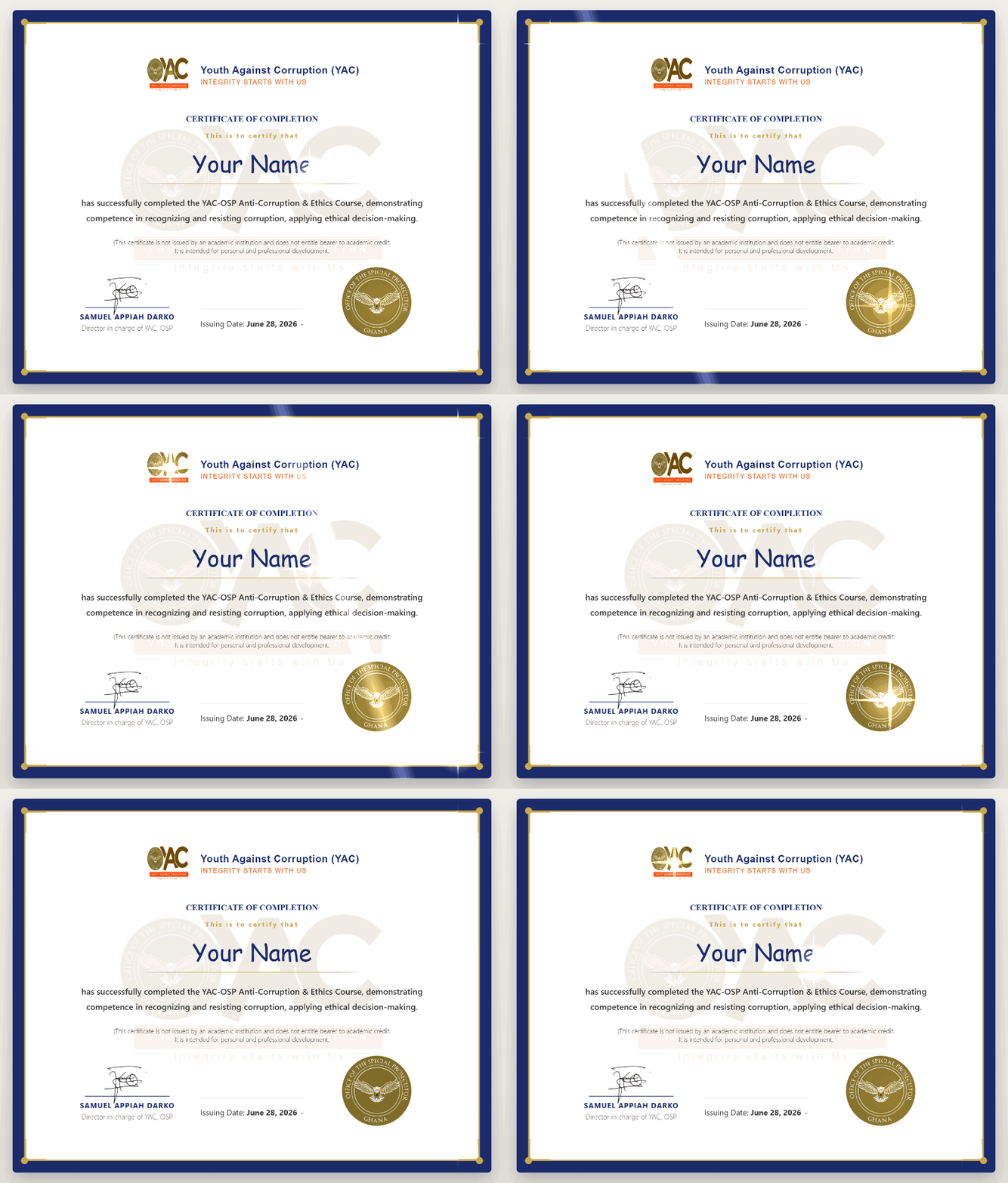
CERTIFICATE OF COMPLETION
This is to certify that
Eugene Fiifi Brown
has successfully completed the YAC-OSP Anti-Corruption & Ethics, demonstrating competence in recognizing and resisting corruption, applying ethical decision-making.
(This certificate is not issued by an academic institution and does not entitle bearer to academic credit:
It is intended for personal and professional development.)
Samuel Appiah Darko Esq.
Director in charge of YAC, OSP